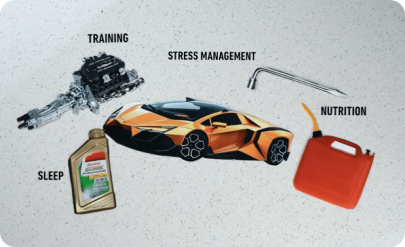
Motivation gets you started. Discipline keeps you going. But what does the neuroscience actually say about building habits that last? And why do some people seem to have an unbreakable routine while others can't stick to a plan for more than two weeks?
The Neuroscience of Discipline
Discipline isn't a personality trait — it's a neural pathway. Every time you repeat a behavior, the neural connections associated with that behavior get stronger through a process called myelination. The more you do something, the more automatic it becomes.
Key Insight
Research from University College London found that it takes an average of 66 days to form a new habit — not 21 days as commonly believed. But the range was 18 to 254 days, depending on the complexity of the behavior and the individual.
Why Motivation Fails
Motivation is driven by dopamine — a neurotransmitter associated with reward and pleasure. The problem? Dopamine is inherently variable. It spikes when something is novel or exciting, then drops as the behavior becomes routine.
This is why:
- Week 1 of a new program feels incredible — dopamine is high from novelty
- Week 3-4, motivation drops — the novelty has worn off
- Week 6+, most people quit — without discipline systems, there's no framework to push through
Building Your System: The Non-Negotiables
The most successful lifters, athletes, and entrepreneurs all share one thing: they have non-negotiable daily systems. Here's how to build yours:
1. Anchor Habits
Attach your new behavior to something you already do consistently. Wake up → drink water → take supplements → train. The existing habit becomes the trigger for the new one.
2. Environment Design
Make the right choice the easy choice. Pack your gym bag the night before. Meal prep on Sundays. Remove junk food from your house. Your environment shapes your behavior more than willpower ever will.
3. The 2-Minute Rule
When you don't feel like doing something, commit to just 2 minutes. Put on your gym shoes. Do one set. Start one meal prep container. Almost always, starting is the hardest part — once you begin, momentum takes over.
4. Identity-Based Habits
Don't say "I'm trying to eat healthy." Say "I'm someone who fuels their body with purpose." When your identity aligns with the behavior, discipline becomes effortless because you're acting in accordance with who you believe you are.
The Role of Sleep in Discipline
This can't be overstated: sleep deprivation destroys self-control. Research shows that just one night of poor sleep reduces prefrontal cortex activity by up to 60%. The prefrontal cortex is responsible for impulse control, decision-making, and willpower.
- Sleep-deprived individuals consume an average of 385 more calories per day
- Reaction time and decision quality drop significantly after <6 hours of sleep
- Growth hormone secretion (critical for recovery) is cut by up to 70% with poor sleep
- Cortisol (stress hormone) increases, promoting fat storage and muscle breakdown
What the Legends Understood
Look at the people who built legendary physiques and careers:
- Dorian Yates trained with brutal intensity for 45 minutes, 4 days a week. No wasted time. Pure focus and discipline.
- Mike Mentzer advocated for less frequent but maximally intense training. His philosophy: quality over quantity, every single session.
- Rich Piana was transparent about the lifestyle — the good, the bad, and the reality of what it takes. He showed up every day regardless of how he felt.
- Chris Bumstead built a dynasty through consistency, not perfection. Training through setbacks, adapting, and showing up.
"Everybody wants to be a bodybuilder, but nobody wants to lift no heavy-ass weights." — Ronnie Coleman. The principle applies to everything: the gap between where you are and where you want to be is filled with discipline, not motivation.
Your Daily Framework
Here's a science-backed daily framework for building an unbreakable lifestyle:
- Morning: Wake at a consistent time. Sunlight exposure within 30 minutes. Hydrate. Move.
- Training: Same time every day if possible. Non-negotiable. Even if it's a light session.
- Nutrition: Meal prep eliminates decision fatigue. Eat according to your plan, not your mood.
- Evening: No screens 60 minutes before bed. Cool, dark room. Consistent bedtime.
- Weekly: One day for meal prep. One day for reflection and adjustment. No zero days.
The Bottom Line
Discipline is a skill, not a gift. It's built through repetition, environment design, and identity alignment. Stop waiting for motivation — build systems that make the right behavior automatic. That's the science. That's the lifestyle.