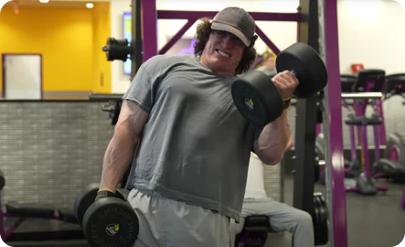
When most people start lifting, they notice pro bodybuilders routinely pushing themselves to their absolute limits and beyond. The natural assumption is that this extreme level of effort must be the reason they're so jacked.
You hear it all the time: "the muscle only knows failure," suggesting you won't make gains unless you push yourself to complete exhaustion. Even some of the most popular fitness influencers train to failure on nearly every single set.
But is that really the best way to train? The science is more nuanced than you might think.
Understanding RIR (Reps in Reserve)
Researchers use a metric called Reps in Reserve (RIR) to measure how hard someone is training. It's a simple concept that changes how you think about every set you do.
- 0 RIR (Failure) — You couldn't have done another rep with good form if your life depended on it.
- 1 RIR — You could've done one more rep with your life on the line, but no more.
- 2 RIR — You stopped with two reps in the tank.
- 3 RIR — You had three more reps left.
Key Finding
Research consistently shows you're likely to make your best gains when you finish your sets with zero to three RIR. If you're finishing most sets with more than three reps in the tank, you're leaving gains on the table.
Does Training to Failure Matter?
Here's where the nuance comes in. Your gains will be about the same whether you train to failure (0 RIR) or just get close to failure (1-2 RIR).
A brand-new study (one of the most significant in recent years) showed basically the same muscle growth between going to failure and stopping with one or two RIR. These were experienced lifters with at least three years of training under their belts.
Training to failure isn't bad — it's just not necessary on every single set. Getting close to failure gives you the same stimulus with less fatigue.
The Fatigue Factor
Why not just go to failure on everything? Because failure generates significantly more fatigue than stopping a rep or two short. This accumulated fatigue can:
- Reduce your performance on subsequent sets
- Increase recovery time between sessions
- Raise injury risk, especially on compound movements
- Lead to form breakdown on technically demanding exercises
Practical Recommendations
Beginners (Less Than One Year of Lifting)
Leave one to three reps in the tank for the majority of your sets. It's much more important to focus on technique at this stage, especially on compound exercises like barbell deadlifts, presses, and squats. If you want to experience what it feels like to train to failure, do it with simple machine or cable exercises toward the end of your workout.
Intermediate to Advanced (More Than One Year)
Take the majority of your working sets to one or two RIR. On low-risk exercises (machines, cables, isolation movements), take the final set to failure. This gives you the best of both worlds: adequate stimulus with managed fatigue.
The Bottom Line
If you never go to failure, you'll never know what 1-3 RIR feels like. That's why taking your last set of each exercise to failure (unless it's deadlifts or squats) is a smart strategy for calibrating your effort.
How to Apply This
If you leave the gym knowing you worked hard, and you're making steady progress toward your goals, keep going. You're doing great. The key is consistency and progressive overload within the 0-3 RIR range.
Don't obsess over hitting failure on every set. Instead, focus on getting close to failure with good form, tracking your progress, and gradually increasing the difficulty over time.