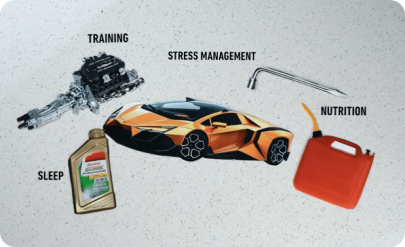
You can have the perfect training program and the most dialed-in nutrition plan, but if your sleep is garbage, you're leaving massive gains on the table. Sleep is when the magic happens — it's when your body repairs, rebuilds, and grows.
Dr. Gina Poe and Dr. Andrew Huberman have discussed extensively how the first phase of sleep is critical for growth hormone release and its alignment with our circadian rhythm. Here's what the science says and how to optimize it.
Growth Hormone and the First Sleep Cycle
Approximately 70-80% of your daily growth hormone (GH) secretion occurs during the first slow-wave sleep (SWS) cycle of the night. This typically happens within the first 90 minutes of falling asleep.
Growth hormone is essential for:
- Muscle protein synthesis and repair
- Fat metabolism and body composition
- Tissue recovery and cellular regeneration
- Bone density maintenance
- Immune system function
Critical Insight
If you miss that first deep sleep phase — whether from staying up too late, alcohol, screens, or irregular bedtimes — you miss the majority of your growth hormone release for the entire day. No supplement can replace this.
Circadian Rhythm and Consistent Bedtimes
Your body operates on a 24-hour internal clock called the circadian rhythm. Growth hormone release is tightly linked to this clock, not just to when you fall asleep.
Research from Dr. Poe's lab shows that consistent bedtimes are one of the most important factors for optimal GH release. Your body anticipates sleep onset and prepares the hormonal cascade accordingly. If your bedtime varies by hours each night, this system gets disrupted.
The Cortisol-Growth Hormone Relationship
Cortisol (your stress hormone) and growth hormone have an inverse relationship. When cortisol is high, GH secretion is suppressed. Going to bed stressed, consuming caffeine late, or sleeping at inconsistent times can elevate cortisol at night and blunt your GH response.
Sleep Architecture for Athletes
A full night of sleep consists of 4-6 cycles, each approximately 90 minutes:
- Stage 1 (N1) — Light sleep, transition phase. 5-10 minutes.
- Stage 2 (N2) — Heart rate drops, temperature decreases. Memory consolidation begins.
- Stage 3 (N3 / Deep Sleep) — Slow-wave sleep. This is where growth hormone is released. Critical for physical recovery.
- REM Sleep — Brain is active, dreaming occurs. Important for learning, emotional processing, and neural recovery.
Athletes and lifters need more deep sleep (N3) than the average person. Training creates micro-damage in muscle fibers that requires repair during deep sleep phases.
10 Evidence-Based Sleep Optimization Strategies
1. Consistent Sleep Schedule
Go to bed and wake up at the same time every day, including weekends. This is the single most impactful change you can make. Aim for within a 30-minute window.
2. Cool Your Room (65-68°F / 18-20°C)
Your core body temperature needs to drop 2-3 degrees to initiate sleep. A cool room facilitates this process. This is one of the most well-supported findings in sleep research.
3. Blackout Your Room
Even small amounts of light can suppress melatonin production. Use blackout curtains or a sleep mask. Cover any LEDs on electronics.
4. No Screens 60-90 Minutes Before Bed
Blue light from phones, tablets, and computers suppresses melatonin. If you must use screens, use night mode or blue-light blocking glasses, though the best option is no screens at all.
5. Cut Caffeine by 2 PM
Caffeine has a half-life of 5-6 hours. That afternoon coffee at 3 PM means 50% of that caffeine is still circulating at 9 PM. It dramatically reduces deep sleep quality even if you can "fall asleep fine."
6. No Alcohol Before Bed
Alcohol is a sedative, not a sleep aid. It fragments sleep architecture, reduces REM sleep, and severely blunts growth hormone release. Even 1-2 drinks significantly impair sleep quality.
7. Morning Sunlight Exposure
Get 10-15 minutes of direct sunlight within 30 minutes of waking. This sets your circadian clock, increases cortisol at the right time (morning), and promotes melatonin release 14-16 hours later.
8. Time Your Training Right
Intense training within 2-3 hours of bedtime can elevate core temperature and cortisol, making it harder to fall asleep. Morning or afternoon training is generally better for sleep quality.
9. Evening Magnesium
Magnesium glycinate (300-400mg) before bed can improve sleep quality. Many athletes are deficient in magnesium due to sweating during training.
10. Aim for 7-9 Hours
Most adults need 7-9 hours. Athletes recovering from intense training may need closer to 8-9 hours. Sleeping less than 6 hours is associated with up to 60% reduction in testosterone and significant impairment of muscle protein synthesis.
The Bottom Line
Sleep is not a luxury — it's the foundation of recovery. Optimize your sleep, and every other aspect of your fitness improves: your training performance, your muscle growth, your fat loss, your mood, and your overall health. No supplement, pre-workout, or training hack can replace quality sleep.